ERP &
I-CBT Therapy for OCD and Anxiety

Two Approaches to OCD Treatment.
One Individualized Plan.

If you’re dealing with OCD, intrusive thoughts, anxiety, or patterns of checking, reassurance seeking, or avoidance, you may have heard about Exposure and Response Prevention (ERP).


You may be less familiar with Inference-Based Cognitive Behavioral Therapy (I-CBT).


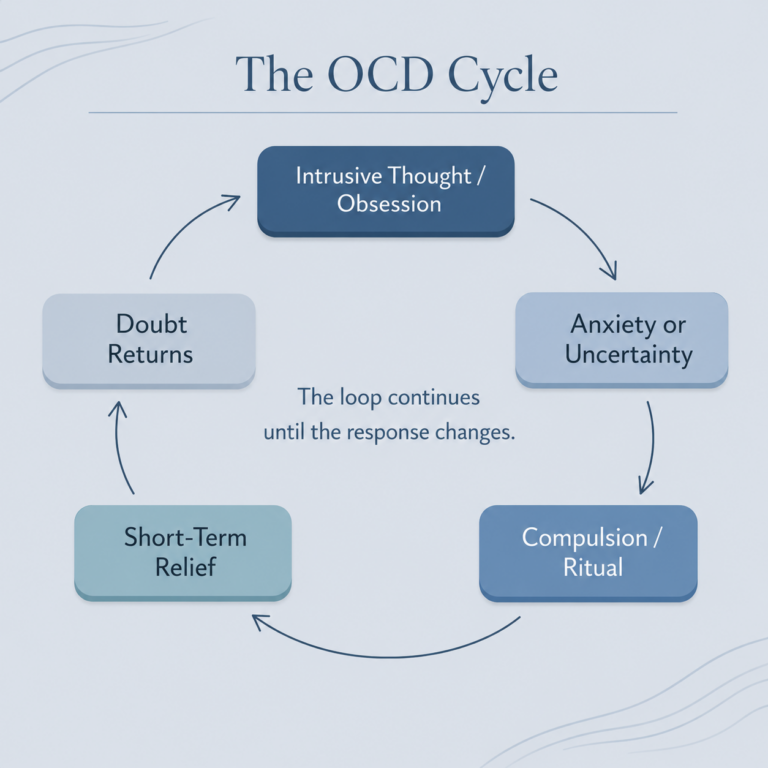
I use both approaches in my work. They address different parts of the obsessive-compulsive cycle, and understanding that difference can help make treatment feel much less mysterious.
 

What Is ERP Therapy?

What Is Exposure and Response Prevention (ERP)?

ERP helps you gradually face situations, thoughts, images, sensations, or uncertainties that trigger anxiety while practicing not engaging in the compulsions you normally use to feel better or more certain.


Those compulsions aren’t always obvious.


Checking and repetitive behaviors count, but so can asking for reassurance, avoiding triggering situations, reviewing conversations in your mind, searching Google for certainty, mentally analyzing whether something is safe, or trying to neutralize an unwanted thought.


What Are We Working Toward?


ERP isn’t about proving that nothing bad will ever happen or achieving complete certainty.


We’re practicing something different: allowing uncertainty or discomfort to be present without immediately responding to it.


Over time, you learn that thoughts and feelings don’t require an immediate response, compulsions aren’t necessary for you to cope, and you can make decisions based on what matters to you rather than what fear is demanding in the moment.

ERP Treatment Therapy | Theresa Schaffer | The OCD Cycle | I-CBT

When ERP Isn't Enough: Inference-Based CBT (I-CBT) for OCD


If you’ve done ERP and the doubt still comes back sounding just as convincing, or if you’ve never been able to picture how exposure work would apply to what you’re afraid of, I want to tell you about another option. Inference-based CBT, usually called I-CBT, is a treatment for OCD that works on how the doubt gets started, before the anxiety and the urge to do something about it ever show up.

What Is Inference-Based CBT (I-CBT)?


OCD rarely starts with a fear. It starts with a doubt: maybe I didn’t lock the door, maybe I’m not really attracted to my partner, maybe I’m capable of something terrible. That doubt doesn’t come from anything you actually saw, heard, or felt. It’s built from stories, possibilities, and “what ifs” that feel so convincing that you end up trusting them more than your own senses.


I-CBT helps you notice the exact moment you cross over from reality into that story, and practice stepping back out. Instead of learning to tolerate a doubt, you learn that you never needed to take it seriously in the first place. For a lot of people, that’s the piece that finally makes sense of why their OCD never fit the textbook.

Who it tends to help

I-CBT is often a good fit if you’ve done ERP and made some progress but hit a wall, if your fears are about your identity, morals, relationships, or your own mind rather than something you can easily expose yourself to, or if your doubts feel so real that the usual “that’s just OCD” doesn’t land. I also use it for health anxiety that behaves a lot like OCD.

ERP vs. I-CBT: What's the Difference?


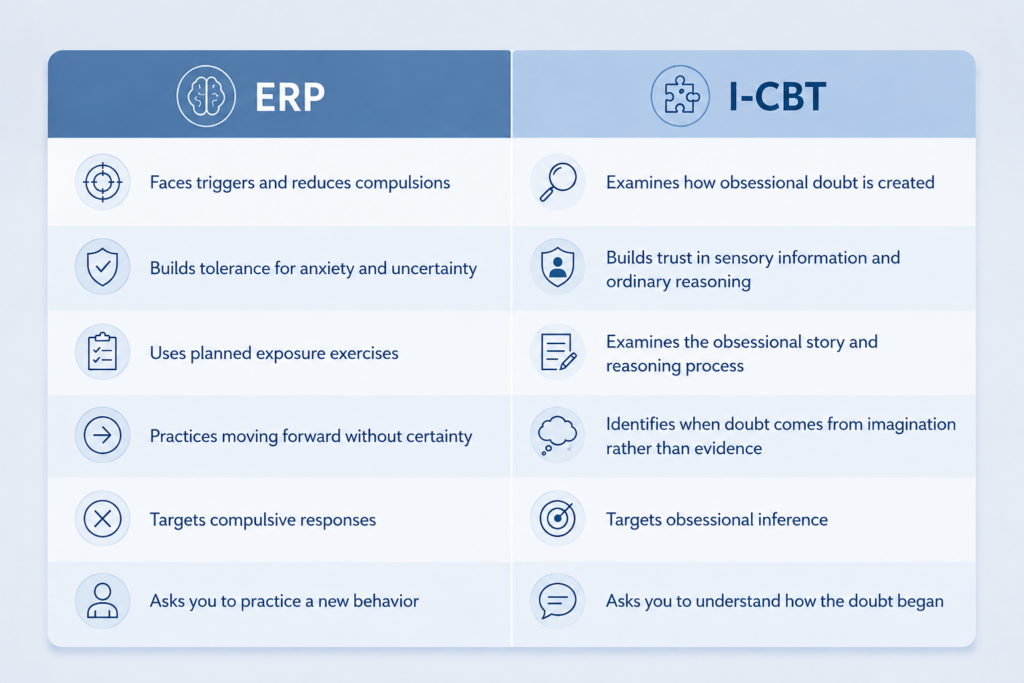
ERP asks: Can I allow this uncertainty and resist the compulsion?

I-CBT asks: How did I arrive at this doubt, and is it based on reality or imagination?


Can ERP and I-CBT Be Used Together?

Sometimes.


For some people, the approaches can complement one another. I-CBT may help you recognize that an obsessional doubt began with an imagined possibility rather than direct evidence. ERP may then help you resist the compulsion if anxiety or uncertainty remains.


The goal isn’t to argue with every thought or reach perfect certainty. It’s to respond to doubt in ways that weaken the OCD cycle rather than strengthen it.


How I Approach OCD & Anxiety Treatment


My approach to treatment is individualized based on what you’re experiencing.

ERP may be used with OCD, generalized anxiety and social anxiety, while I-CBT provides another specialized approach for understanding and treating obsessional doubt in OCD.


Obsessive-Compulsive Disorder (OCD)

Obsessive-Compulsive Disorder (OCD)

With OCD, I may use ERP, I-CBT, or elements of both approaches. ERP focuses on changing how you respond to obsessional fear and uncertainty, while I-CBT examines how the obsessional doubt was created in the first place.
Learn More About OCD Therapy

Anxiety Disorders

Anxiety Disorders

When appropriate, ERP can help you gradually face feared situations, thoughts, sensations, or uncertainty while practicing a different response, without relying on the behaviors you've been using to reduce anxiety or feel certain.
Learn More About Anxiety Therapy

Panic Disorder & Panic Attacks

Panic Disorder & Panic Attacks

After experiencing a panic attack, it's common to become afraid of the sensations associated with panic, or to start avoiding situations where you're worried another attack might happen. Exposure-based treatment can help reduce that cycle of fear and avoidance by gradually changing how you respond to feared sensations and situations.
Learn More About Panic Attacks
Theresa Schaffer, LCSW, Anxiety Specialist in Atlanta | Online Atlanta Substance Use Counseling | Theresa Schaffer | Online Anxiety Therapy Delaware | Anxiety Therapist in Delaware | Theresa Schaffer | Online OCD Therapy Delaware | OCD Therapist in Delaware | Theresa Schaffer

Specialized OCD & Anxiety Treatment

Theresa Schaffer, LCSW

Licensed Clinical Social Worker · OCD, Panic & Anxiety Specialist · Atlanta, GA


I specialize in treating OCD, anxiety, panic disorder, intrusive thoughts, health anxiety, and related conditions.


My approach is active, individualized, and grounded in evidence-based treatment. Because I’m trained in both ERP and I-CBT, I’m able to look at not only how you’re responding to anxiety and obsessional doubt, but how that doubt may be developing in the first place.


You don’t need to arrive knowing which treatment you need. We’ll figure that out together.


FAQs

Honest answers to what most people wonder

Exposure and Response Prevention (ERP) is an evidence-based treatment commonly used for OCD. It involves gradually facing situations, thoughts, images, sensations, or uncertainties that trigger anxiety while practicing not engaging in compulsions.

Compulsions aren’t always visible behaviors. They can include checking, asking for reassurance, avoiding certain situations, reviewing memories or conversations, searching online for certainty, or mentally analyzing whether something is safe.

Through ERP, you practice allowing discomfort and uncertainty to be present without responding in the usual compulsive way. The goal isn’t to achieve perfect certainty. It’s to learn that you can move forward without needing to resolve every doubt first.

Inference-Based Cognitive Behavioral Therapy, or I-CBT, is an evidence-based treatment developed specifically for OCD. It focuses on understanding how obsessional doubt gets created in the first place.

With OCD, your mind may move away from information that’s available in the present moment and become absorbed in an imagined possibility, something that could be wrong, even when your senses or direct experience aren’t giving you a reason to doubt.

I-CBT helps you examine how you arrived at the doubt and recognize whether it’s based on direct evidence or an imagined possibility.

ERP and I-CBT address different parts of the obsessive-compulsive cycle.

ERP asks: Can I allow this uncertainty and resist the compulsion?

I-CBT asks: How did I arrive at this doubt, and is it based on reality or imagination?

ERP focuses primarily on changing how you respond when obsessional fear or uncertainty appears. I-CBT focuses more on understanding and correcting the reasoning process that created the obsessional doubt.

In simple terms, ERP works with your response to the doubt, while I-CBT looks more closely at where the doubt came from in the first place.

Yes. For some people, ERP and I-CBT can complement one another.

For example, I-CBT may help you recognize that an obsessional doubt began with an imagined possibility rather than direct evidence. If anxiety or uncertainty remains, ERP may then help you resist the urge to check, seek reassurance, avoid, or perform another compulsion.

The goal isn’t to argue with every thought or achieve perfect certainty. It’s to respond to doubt in a way that weakens the OCD cycle rather than strengthens it.

I-CBT does not use planned exposure exercises in the same way ERP does. Instead, it focuses on examining the obsessional story and reasoning process that created the doubt.

I-CBT helps you recognize when your mind has moved away from information available through your senses and direct experience and into an imagined possibility. You learn to distinguish between ordinary doubt and obsessional doubt and reconnect with what you know from present-moment information.

Absolutely. ERP can be provided effectively through online therapy. Because many OCD triggers and compulsions occur in everyday environments, virtual sessions can even provide opportunities to work with situations that are directly relevant to your daily life.

We can identify triggers, develop appropriate exposure exercises, practice response prevention, and review what you’re learning through secure virtual sessions. ERP is always individualized and collaborative—you aren’t forced or deceived into exposures, and the work progresses gradually.

You don’t need to decide that before beginning therapy.

When we meet, I’ll take time to understand the doubts, obsessions, compulsions, reassurance seeking, avoidance, or other patterns you’re experiencing, as well as any OCD treatment you’ve tried in the past.

From there, we can determine whether ERP, I-CBT, or elements of both approaches make sense for you. I don’t assume that every person with OCD needs an identical treatment plan.

Ultimately, both approaches share an important goal: helping you step out of the obsessive-compulsive cycle, reduce compulsions and avoidance, develop a healthier relationship with doubt, and spend less time trying to achieve impossible certainty.

Ready to Learn More?

If OCD, anxiety, intrusive thoughts, compulsions, or avoidance are taking up more of your time and attention than you’d like,

we can talk about what’s happening and what treatment may make sense for you.


You don’t need to know whether ERP or I-CBT is the right approach before you contact me.

That’s something we’ll determine together based on what you’re experiencing.